Salary-linked credit, from employer to payday
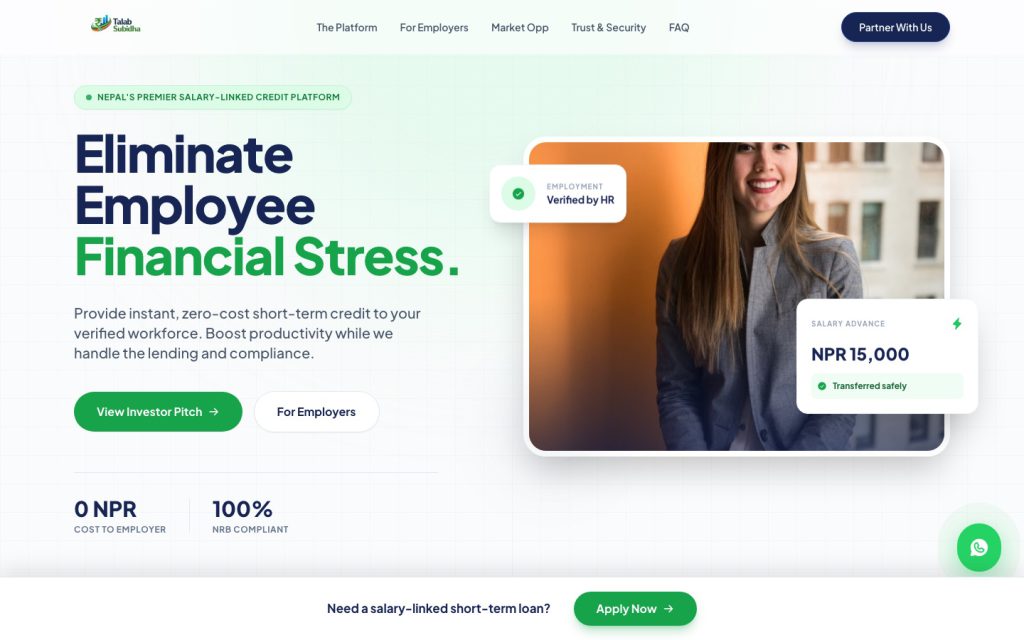
Talab Subidha is a salary-linked short-term credit platform for salaried workers in Nepal. We handled its application development, and this page covers the parts anyone can see: the site, the loan calculator and the online application.
- Fintech platform
- Application development
- ID and selfie verification
The client
Talab Subidha offers salaried employees short-term credit linked to their salary. The model on its site has three parties: the employer verifies the employee and their salary cycle, a licensed lending partner approves and pays out the money, and repayment comes back through payroll deduction or a scheduled bank debit on payday.
The site says it works through licensed Class C and D financial institutions, so Talab Subidha runs the technology and acquisition while its partners do the lending. It's also open about its stage: it's looking for investors and lending partners to support a pilot deployment.
What they needed
The platform has to speak to three audiences at once. Employers need to know what offering it costs them, which the site states is nothing. Investors and lending partners need the model and the compliance structure. Employees need a quick way to apply.
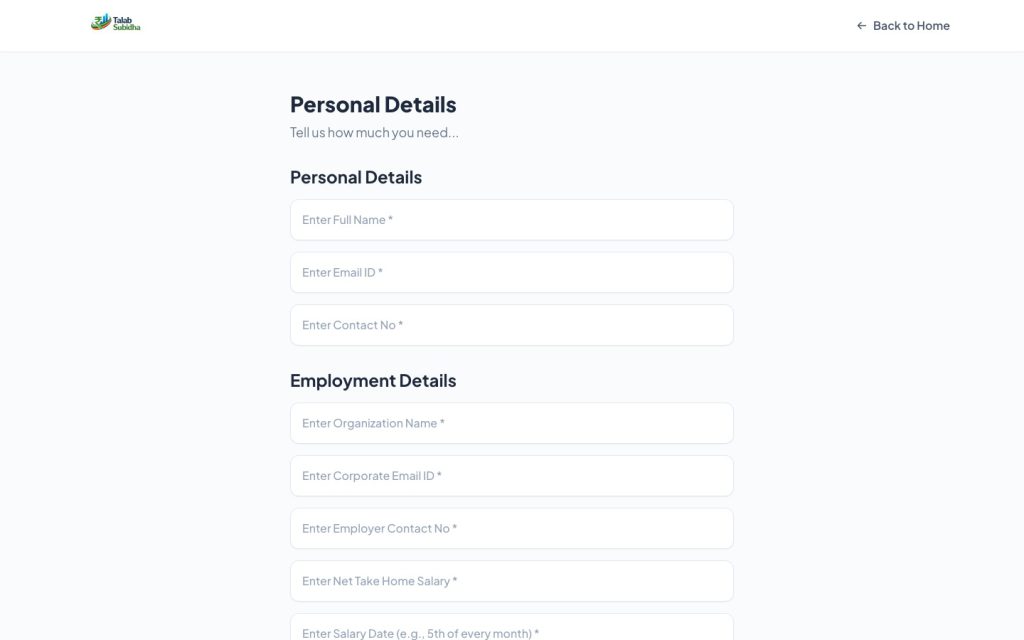
The application itself had to collect enough to verify a salaried applicant (who they are, who employs them, what they earn and when they're paid) without sending them to a branch. And the fees had to be shown up front, so the platform needed a calculator applicants could try before they apply.
What we built
The public side of the platform: a single-page site for employers and investors, a fee calculator and a structured online application.
Platform and employer pages
Sections explaining the platform, the three-step model, the case for employers, the market, and trust and security, all on one page with anchor links.
Loan calculator
Sliders for amount, tenure and processing fee that show the estimated fee and total repayment straight away, with a note that real terms depend on the employer agreement and lender.
Online application
A form in three parts: personal details, employment details such as employer, net salary, salary date and days worked, then verification and payment details.
ID and selfie upload
Applicants upload a citizenship card, national ID, licence or employer card as an image or PDF, and take a selfie with the phone's front camera.
Investor and employer enquiries
Pop-up forms for investors and for employers who want to offer the benefit, plus a general contact form.
Always-on apply prompt
A fixed bar with an apply button and a WhatsApp chat link, so an employee can start an application from anywhere on the page.

Stack
Detected from the live site's HTML, scripts and response headers. The employer and lending back end isn't public, so it isn't listed here.
| Layer | Technology |
|---|---|
| Pages | Static HTML, one landing page and one application page |
| Styling | Tailwind CSS with a custom brand palette, Plus Jakarta Sans |
| Interface | AOS scroll animations and Phosphor Icons |
| Forms | Asynchronous submission through FormSubmit, with file uploads and a honeypot field against spam |
| Hosting | LiteSpeed web server |
How we worked
This is how we run application projects of this kind.
Map the users and the flows
We list every role that touches the product and write down what each one needs to do, start to finish.
Scope a first release
The flows that prove the model go into the first release. The rest goes on a written backlog, not into the first build.
Build in short iterations
Working screens are demoed regularly, so the client reviews real software rather than documents.
Test with real data paths
Forms, uploads, notifications and hand-offs to third parties are tested end to end before anyone outside the team sees them.
Support after launch
We stay on to fix issues, keep dependencies current and add features from the backlog.
Have a project like this?
Book a 30-minute discovery call. Walk us through the users, the partners and the rules your product has to follow, and we'll send a written proposal within two working days.
