
We offer the following services to support your AI Development.
offering the opportunity to redefine customer journeys, automate internal workflows, and leverage superior intelligence throughout your business operations. Dignep’s experts are here to help you unlock this potential and realize its full potential today.
✦ Our Approach
Leverage our state-of-the-art custom Al services that automate mundane processes and strengthen business intelligence.Our enterprise Generative AI (GenAI) solutions are all about unlocking the power of Large Language Models (LLMs) for your business. We customize these models to fit your specific needs and help you achieve your goals.
1
Discovery
Al software development services involves analyzing your business data, challenges, and potentiality to map out new business opportunities, secure use cases, and outline the course of development.
2
Design
During this phase, our Al app developers and designers finalize the feature set and technologies to be used while creating a working prototype to be tested.
3
POC
As a leading Al services company, engage in the training and tuning of artificial intelligence algorithms while continuously testing them to ensure their viability.
4
Implementation
Al application is engineered based on best Al development practices. The ML model is then integrated into the app, which is then launched in the desired environment.
Bringing your AI vision to its fullest potential.
We can help you navigate and evolve with the transformative impact of Artificial Intelligence that is reinventing the world as we know it. Streamline workflows, unlock invaluable insights, and redefine efficiency.
Whether you’re a startup trying to launch a business or an enterprise looking to scale up, there’s definitely something we can do for you.
Access top-tier AI talent Machine Learning Engineers, Data Scientists, Data Engineers, and Data Annotators through our expert IT staffing services, focused exclusively on AI Development.
Learn MorePartner with us for your AI development needs. You focus on growing your business while we manage all the technical challenges.
Learn MoreLeverage our team of AI experts to develop Cutting-Edge AI Solutions. Our development service the full spectrum of AI project development.
Ensure precise labeling of your datasets by hiring our expert data annotators, boosting the accuracy and effectiveness of your AI models.
AI Software Development Steps
Below, our AI consultants outline a high-level overview of the AI development process. The final scope and deliverables of each step depend on the specifics of each case, including the business model and the complexity of your solution.
Business analysis and solution conceptualization

For enterprises: analysis of business goals to be achieved with AI; analysis of corporate infrastructure, operations, data governance and management practices; analysis of end users’ needs and expectations.
For software product companies: creating the competitive advantage framework (e.g., identifying competitors, the target audience, and features to win the competition).
Defining functional and non-functional solution requirements, including the exact AI capabilities; solution performance, scalability, latency characteristics; relevant compliance regulations (e.g., HIPAA, GDPR, PCI DSS).
Defining the project scope, estimating costs and timelines, and developing a risk mitigation plan.
Choosing between ready-made and custom AI models
For cases where pre-trained models bring cost-savings while ensuring high-quality output: choosing the optimal pre-trained model (e.g., a GPT model, a model from PyTorchHub or Spacy library), depending on the use case, licensing limitations, and costs.
For innovative, experimental, or precision-sensitive cases: building a proprietary ML model, including architecture design, algorithm training and optimization, hyperparameter tuning, and other steps.
Choosing between ready-made and custom AI models
For cases where pre-trained models bring cost-savings while ensuring high-quality output: choosing the optimal pre-trained model (e.g., a GPT model, a model from PyTorchHub or Spacy library), depending on the use case, licensing limitations, and costs.
For innovative, experimental, or precision-sensitive cases: building a proprietary ML model, including architecture design, algorithm training and optimization, hyperparameter tuning, and other steps.
In most cases, custom development is not required. There is a large selection of available open-source or licensed AI models that can perform common tasks such as speech recognition or content generation. Whenever there are high-quality, pre-trained models that are cheaper and faster to implement than custom ML algorithms, we recommend this option first. For example, we built a solution based on five open-source NN models for a client who wanted to implement NLP for help desk software. At the same time, while open-source models have no upfront costs, they may lack support or comprehensive documentation. And licensed AI models, such as those from Microsoft and Amazon, will require ongoing fees and may have usage restrictions.
AI-powered software design
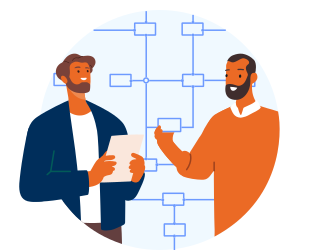
Designing solution architecture, backend, and integrations.
Designing user-friendly UX/UI to ensure convenience for end users and smooth user adoption (for enterprises).
If the drawbacks of either option are unacceptable or there’s no suitable pre-trained model in the first place, it makes sense to go for custom AI development. I’m talking about cases like medical diagnosing, credit risk assessment, or quality control in car manufacturing — areas where precision and security are non-negotiable. Here, a cost-saving approach would be to tailor and re-train an existing model. However, it’s also possible to build one fully from scratch using publicly available or internal data sets.
AI solution development
For pre-trained models: model fine-turning and integration.
For proprietary models: performing data collection, exploratory data analysis (EDA), and data cleansing; splitting the data into training, validation, and test sets; model training and fine-tuning based on the demonstrated performance.
Non-AI part development: implementing DevOps and coding the server side of the solution; performing the required testing and QA procedures, automating QA when applicable.
Deployment and integration

Launching the ML/AI model on live data within the solution to get and assess the initial output.
Handling errors and exceptions, e.g., when the model provides errors such as unexpected output.
Configuring solution infrastructure and implementing reliable network security mechanisms.
Deploying the software with the integrated ML/AI model to the target environment.
Testing and validating model performance and accuracy in this environment.
Scaling and optimizing the model to make sure it can handle the expected workload. Integrating the solution with the required corporate and third-party systems (if applicable).Integrating the model with the UI (e.g., a web page, an analytics dashboard, a customer portal).
Testing the entire solution.
Setting the AI solution live.
Introducing a custom AI adoption strategy (for enterprises)
To facilitate organizational changes entailed by AI adoption, businesses may require practical assistance with the following:
Upgrading corporate data governance and management policies to simplify access to data, eliminate data silos, and make sure the ML/AI-powered solution doesn’t use low-quality data.
Designing a plan for adapting employee workflows to the introduced software, including the creation of policies specific to new roles.
Creating user tutorials and maintenance guides to be used by the in-house IT team.
Conducting employee training in a convenient format, e.g., live, remote, hybrid.
Continuous solution evolution and optimization (if needed)
Monitoring and optimization of solution performance.
Promptly detecting and fixing arising issues, e.g., with security, compatibility.
Adjusting UX/UI based on user feedback.
Fine-tuning and re-training the ML/AI model to further improve its accuracy.
Adding new AI-powered capabilities if needed.
AI development services help get ML-powered solutions that automate repetitive tasks, instantly process large amounts of data and deliver insights, generate content and visuals, and more.
According to a report by Grand View Research, the worldwide artificial intelligence market is expected to grow at a CAGR of 36.6% from 2024 to 2030, with AI becoming an integral part of business operations and consumer-facing applications.
At Dignep, we start artificial intelligence development by creating a 100% secure environment for data processing and storage during AI development, applying our best security management system and DevSecOps best practices throughout the SDLC. If we use sensitive data to train an AI model, we anonymize it to avoid the risk of data breaches.
To make sure the AI solution itself doesn’t pose unnecessary risks, we implement data encryption at rest and in transit and robust role-based access control mechanisms. Additionally, we employ data masking, enforce strict logging and monitoring practices, and utilize advanced threat detection mechanisms such as ML-based intrusion detection.
Our compliance experts make sure the AI solution aligns with regional and industry-specific regulations and standards, including HIPAA, GDPR, KYC/AML, and more. We also guarantee transparency for users: they get clear explanations of what personal data is being collected and what for and are asked for consent to data collection and processing.
In such cases, we recommend starting with a proof of concept to check the idea’s feasibility in the shortest possible timeframe. Designing a proof of concept (PoC) is a good way to showcase how the solution will work, estimate the potential value, address major concerns, and draw up a risk mitigation strategy. PoC is also the best choice for a startup company to get a demo version of the future app and use it to attract investments. PoC is highly recommended for innovative AI solutions, where there may be several technology choices that haven't been tested before.
Indeed, data quality largely determines AI output accuracy. However, quality is not an inherent or objective attribute of any data set. Each project has different requirements, so even if the quality of your data is lower than expected, our data engineers can improve it to achieve the desired level. Our professionals use automated tools to assess, cleanse, and deduplicate the data to avoid human error and save time. In case your data is insufficient, we can also enrich it by using external sources (e.g., financial data marketplaces, social media, GIS).
The need for human involvement depends on the case. High-risk tasks like medical image analysis may require constant human presence to verify the AI output, while lower risk tasks (e.g., data entry) will require zero or close to zero human participation. Here are some of the key factors that affect AI output quality, depending on the use case:
- Data quality and quantity. Training data should be clean, relevant to the use case, and representative of the future input that AI will process. Since larger datasets often lead to a higher quality of output, we strive to collect as much data as necessary and can augment the data sets provided by our clients. For example, we can get additional data from relevant online sources with the help of web scraping tools or use generative adversarial networks (GANs) to generate synthetic data for the training set.
- Model selection and training. Depending on the project specifics, we select ML models that will ensure adequate output accuracy and an acceptable cost-to-performance ratio. For highly innovative cases, we develop custom ML models.
- Model validation and testing. We implement robust ML validation and testing mechanisms, including cross-validation.
- Evaluation metrics. We define and apply clear evaluation metrics that align with the AI solution’s goal. Common metrics include precision, recall, F1-score, and mean squared error. We monitor and evaluate model performance using these metrics.
- Human-in-the-Loop (HITL). Depending on the use case and criticality of the output, it may be necessary to implement the Human-in-the-Loop (HITL) system. This involves human reviewers who can validate or adjust the AI output when necessary. It may be recommended for cases like content moderation, medical diagnosing, and legal document review.
- Feedback loop. After every iteration, the AI output is submitted for an expert review. The feedback is then incorporated into the next version of the model to improve its accuracy.
- Monitoring and alerting. We can implement monitoring and alerting systems to detect anomalies or drops in model performance. This allows for proactive intervention when AI accuracy degrades.
Currently, the best way to avoid harmful biases in AI output is to build your software in alignment with UNESCO's Human Rights Approach to AI. To do this, we recommend starting artificial intelligence software development with Human Rights Impact Assessments (HRIA) to identify potential cases where the technology may affect individuals’ rights. When conducting the research, it’s essential to combine domain expertise with feedback from multiple stakeholders, including potential end users and representatives of affected communities.
Ready to take the next step?
Want to accelerate software development at your company? See how we can help.